Radio Interview with Orange County Partnership for Young Children
Margaret Samuels, the Executive Director of the Orange County Partnership for Young Children, and Board Chair Jay Bryan, appeared on the Chapelboro radio station to explain how Smart Start serves families in Orange county. They also discuss the history of the Smart Start system and the new NCPK (formerly More at Four).
Listen to the segment on Chapelboro.com.
Court Ruling First Ever to Acknowledge Importance of Birth to Five in Education Continuum
FOR IMMEDIATE RELEASE
National Leaders Tout North Carolina Landmark Decision
Raleigh, NC—North Carolina Superior Court Judge Howard Manning, Jr. issued the first court ruling that acknowledges the pivotal role early education plays in allowing at-risk children to avail themselves of their right to a sound basic education. He issued the ruling earlier this week. Leaders from around the country are touting the landmark decision.
“To my knowledge, this is the first time that a court has recognized what decades of scientific research have shown—that the foundation for learning (whether strong or weak) is built long before a child starts kindergarten. Indeed, science tells us that early experiences literally shape the architecture of the developing brain. With this knowledge as a context, the Court’s decision is legally responsible, economically wise, and morally commendable,” said Jack P. Shonkoff, M.D., Director of the Center on the Developing Child at Harvard University.
“This will be a moment written about in future history books. For the first time, a court has acknowledged the influential role of early learning, beginning at birth, in the education continuum,” said Charles Kolb, president of the Committee for Economic Development. “The ruling is based on the same profound science that has rallied business leaders to support quality early education as part of America’s education system. North Carolina is once again making early education history. I can only hope that the rest of the country will not be far behind.”
The ruling is part of the long-running Leandro case. That case established the standard that all children have the constitutional right to a sound basic education. In 2000, Judge Manning said that the state was obligated to provide pre-kindergarten education to “at-risk” children. North Carolina began More at Four in response to the ruling. In June, the court held a hearing in which the Leandro plaintiffs challenged the budget cuts enacted by the legislature for the coming year, particularly the changes to More at Four.
Throughout the decision, Judge Manning emphasized the importance of early education, calling particular attention to Smart Start, North Carolina’s early childhood system that serves children birth to five. “Put another way, each at-risk child under age 4 that is receiving services from Smart Start will be better prepared, physically and developmentally, to benefit from NCPK’s educationally based prekindergarten programs when they arrive at age 4.” Judge Manning wrote.
He noted, “The bottom line . . . is that the State, using the combination of Smart Start and the More at Four Pre-Kindergarten Programs, have indeed selected pre-kindergarten combined with early childhood programs, as the means to ‘achieve constitutional compliance’ for at-risk prospective enrollees.”
The ruling is online at http://bit.ly/mQxCoy.
###
Smart Start is the system that brings together all the people involved in a young child’s life—families, teachers, doctors, caregivers, social workers, and many others—to ensure every child has all they need for healthy growth and development. For more information, visit www.smartstart.org
NC Judge Rules for First Time in U.S. that Early Education Vital to Right to Sound Basic Education
Superior Court Judge Howard Manning, Jr. has issued another groundbreaking ruling in the long-running Leandro lawsuit by acknowledging the pivotal role early education plays in allowing at-risk children to avail themselves of their right to sound basic education.
“The bottom line is that Smart Start and the MAF program-now NCPK (prekindergarten) under the present law, are intertwined in terms of administration, funding support and the continuity of early childhood services which Smart Start provides to the little children beginning at birth through age 5. Put another way, each at-risk child under age 4 that is receiving services from Smart Start will be better prepared, physically and developmentally, to benefit from NCPK’s educationally based prekindergarten programs when they arrive at age 4.”
Superior Court Judge Howard Manning , Jr.“. . . the State, using the combination of Smart Start and the More at Four Pre-Kindergarten Programs, have indeed selected pre-kindergarten combined with the early childhood benefits of Smart Start and its infrastructure with respect to pre-kindergarten programs, as the means to ‘achieve constitutional compliance’ for at-risk prospective enrollees.”
Superior Court Judge Howard Manning , Jr.
Statement by Dr. Olson Huff, Board Chair of The North Carolina Partnership for Children, Inc.
“Today is truly extraordinary. For the first time ever, a United States court has said that a child’s ability to access his or her right to obtain a sound basic education begins at birth. Once again, North Carolina makes early learning history.
The court’s position reflects decades of scientific research that demonstrates that the brain is hard-wired for learning in the first five years of life. Waiting until children enter kindergarten, or even pre-kindergarten is too late.
We know investing from birth works. Judge Manning cited the 2011 research from Duke University that showed that North Carolina third-graders have higher standardized reading and math scores and lower special education placement rates in counties that received more funding for Smart Start and More at Four when those children were younger.
The ruling also articulates what those involved in the system have always known. Just as local education agencies are the system for delivering K-12 educational services, Smart Start is the system for delivering early learning educational services.”
Download Judge Manning’s Ruling.
Raleigh Pediatrician and Smart Start Board Member Named to Child Fatality Task Force
Peter Morris, M.D., Medical Director of Wake County Human Services named to key child safety task force by Governor Perdue
Peter J. Morris, M.D., MPH, Medical/Clinical Services Director of Wake County Human Services and Board Member of The North Carolina Partnership for Children, Inc., the organization that leads Smart Start, has been appointed by Governor Beverly Perdue to serve on the North Carolina Child Fatality Task Force.
Dr. Morris serves as Vice-Chair of the Board of Directors of Action for Children North Carolina and will represent the organization on the Task Force.
“The task force has worked long and hard to study how best to prevent child deaths and improve the quality of lives for children, their families, and their communities,” said Dr. Morris. “It is an honor to join them in their work advising public policy.”
The Child Fatality Task Force was created in 1991 by the General Assembly to study the causes of death in childhood and to develop a system for the multidisciplinary review of child deaths. The impetus for creating the Task Force was to address the problem of child abuse, but the focus of the Task Force quickly expanded to include all child deaths.
Dr. Morris replaces Tom Vitaglione, Senior Fellow for Health and Safety at Action for Children North Carolina, who is retiring in August.
For more information, visit www.ncchild.org.
The Worth of Children’s Programs
As policymakers debate the merits of the best approach to improve children’s academic success, they would be well served by reading an op-ed published today in the News Observer. Duke University researchers remind us that “research scientists like ourselves can be helpful in sorting out the effectiveness of strategies that have been implemented to achieve common goals.”
They note that “over the past two decades, to realize the goal of improving children’s academic success, North Carolina has tried a strategy of investing in the first five years of life.” They are referring to Smart Start and More at Four. Kenneth Dodge, Helen Ladd, and Claire Muschkin from Duke studied these programs, asking “Do these programs work? Have they made our children better off academically?” The answer was emphatically yes. They write:
“We have analyzed data on educational outcomes for third graders over the past 12 years and find that children who were lucky enough to be born into a county at a time that it received financial support for these programs perform better in third grade than children born into that county at a time when it received less funding for these programs.
‘Perform better’ means higher average third-grade standardized test scores in reading and mathematics and fewer placements into special education for problem performance.
How much better? About a half year of schooling and 15 percent fewer special education placements. In the world of education, that is a lot better
Who benefits from these programs? The benefits we identify include not only those to children who directly participate in the programs, but to others as well. All children of a target age in a county benefit by increased standards for child care, curricula and preschool teacher qualifications. Furthermore, imagine a kindergarten classroom where more children begin the year ready to learn. The teacher will spend less time managing behavior problems and remediating children who are way behind, and more time teaching the entire group of children. Everyone benefits.
Some have asked whether both of these programs are needed. Could the state cut one program and get just as much benefit by continuing the other program?
Our findings indicate no. Each program generates a unique benefit, and the two programs yield twice as much benefit as one program.”
The researchers conclude, “The proposed state budget cuts these early childhood programs by more than 20 percent. Our analyses of the data indicate that the current level of funding for both these programs is well worth the investment.”
We need to encourage our elected officials to base their decision on the facts. Please forward this op-ed to your networks!
McDowell Teacher Receives Karen W. Ponder Leadership Award
MARION — Joy Griffith, an early childhood education teacher at McDowell Technical Community College, was awarded the Karen W. Ponder Leadership Award at the 2011 National Smart Start Conference.
The award, named for Smart Start’s former president, recognizes outstanding service to young children and families in North Carolina. Griffith was nominated by the McDowell County Partnership for Children. A $1,000 cash award will be made to the partnership in her name.
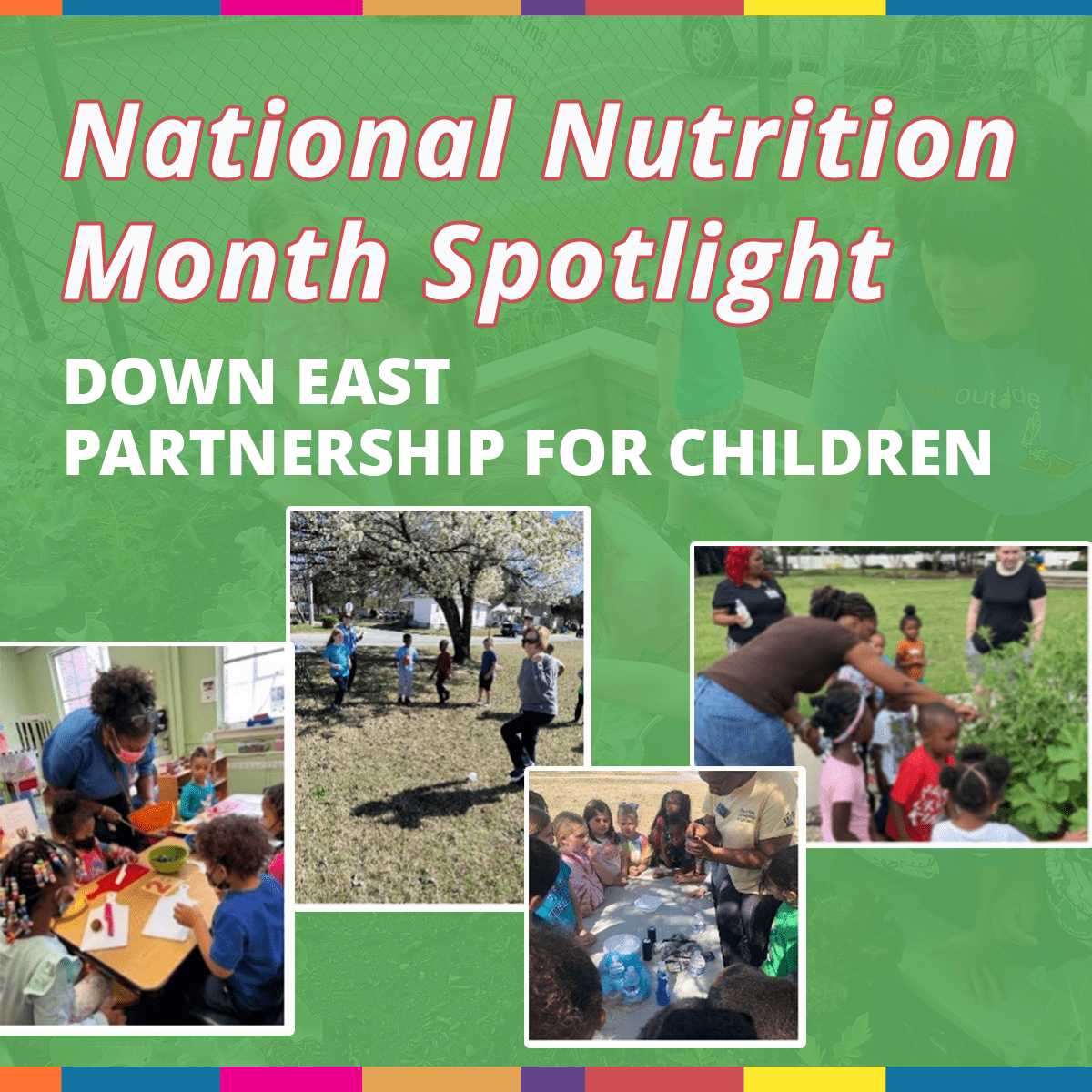
Down East Partnership for Children on The Break Away Show
The Down East Partnership for Children was interviewed for a segment on The Break Away Show. Program Director Wendy Price does an excellent job explaining the services available to families, including helping parents find quality child care and parent education programs. Check out the 3-minute segment on the show’s website.
Smart Start Receives Clean Audit Report
FOR IMMEDIATE RELEASE
RALEIGH-For the ninth consecutive year, The North Carolina Partnership for Children, Inc. (NCPC) has a “clean bill” of financial health, according to the Office of State Auditor. An audit of Fiscal Year 2009-2010 Smart Start activities found the organization was in compliance and had appropriate internal controls. NCPC is the organization that oversees Smart Start and is audited annually.
In the past ten years, NCPC and Smart Start local partnerships have been audited more than 450 times by State auditors and/or independent auditors hired by the state. NCPC has had no audit findings for the past nine years. In the past two years, 77 partnerships were audited, and had no findings.
Auditors look for compliance in three core areas: accuracy of financial statements; how the partnership processes and authorizes transactions such as grants, accounts payable, payroll and cash receipts; and contract compliance.
“Smart Start is a public-private partnership with the highest standards of accountability. This latest clean audit reflects those high standards. Smart Start is a trusted partner that works effectively and efficiently to serve young children,” said Dr. Olson Huff, Chair of the NCPC Board of Directors.
Smart Start is an early childhood leadership network that leverages private and public dollars to address issues critical to North Carolina’s young children and future workforce. The initiative serves all 100 North Carolina counties and is administered by 77 local Smart Start partnerships that create community-based programs. Smart Start financially supports programs that increase the number of quality early childhood programs, provide education for early childhood workers, support parent education programs and connect families with medical services.
NCPC places great emphasis on local control, coupled with strict accountability, oversight and measures to ensure financial integrity.
###
The earliest years of childhood are critical. Experiences during this time literally shape the structure of the brain. Because today’s children are tomorrow’s leaders, parents and workers, everyone has a stake in making sure all children have the experiences they need to thrive. Smart Start is the system that brings together all the people involved in a young child’s life—families, teachers, doctors, caregivers, social workers, and many others—to ensure every child has all they need for healthy growth and development. For more information, visit www.smartstart.org.
Smart Start in Action
Lucy Daniels Center and Smart Start from Together NC on Vimeo.
North Carolinians understand that the future of our state depends on ensuring that our young children birth to five have the early intervention and quality education to succeed in kindergarten and beyond.
That’s why our General Assembly created Smart Start, our nationally-recognized infrastructure for early childhood education.
Through 77 local partnerships that serve all 100 counties, Smart Start serves hundreds of thousands of children every year. Smart Start’s success has been verified repeatedly in more than 37 independent studies, including a recent Duke University study that showed that Smart Start increases third grade test scores and reduces the need for special education.
Investments in quality early child education pay off and Nobel-prize winning economist James Heckman has found that such investments yield higher returns than those in higher education or job training.
If you’re concerned about the fate of Smart Start and other public investments, visit http://www.speaknc.org/2011/04/lucy-daniels-center-and-smart-start/.org to learn more.